Workforce Pell Changes the Equation: Why Teaching Quality Is Now Central to Workforce Outcomes
By Dr. Mildred Coyne, CEO, Coyne Workforce Solutions.
Share:




The expansion of Pell funding to include short-term workforce programs marks a significant shift for US community colleges, increasing access for learners seeking faster routes into employment and enabling institutions to expand employer-aligned programs in sectors where workers are urgently needed.
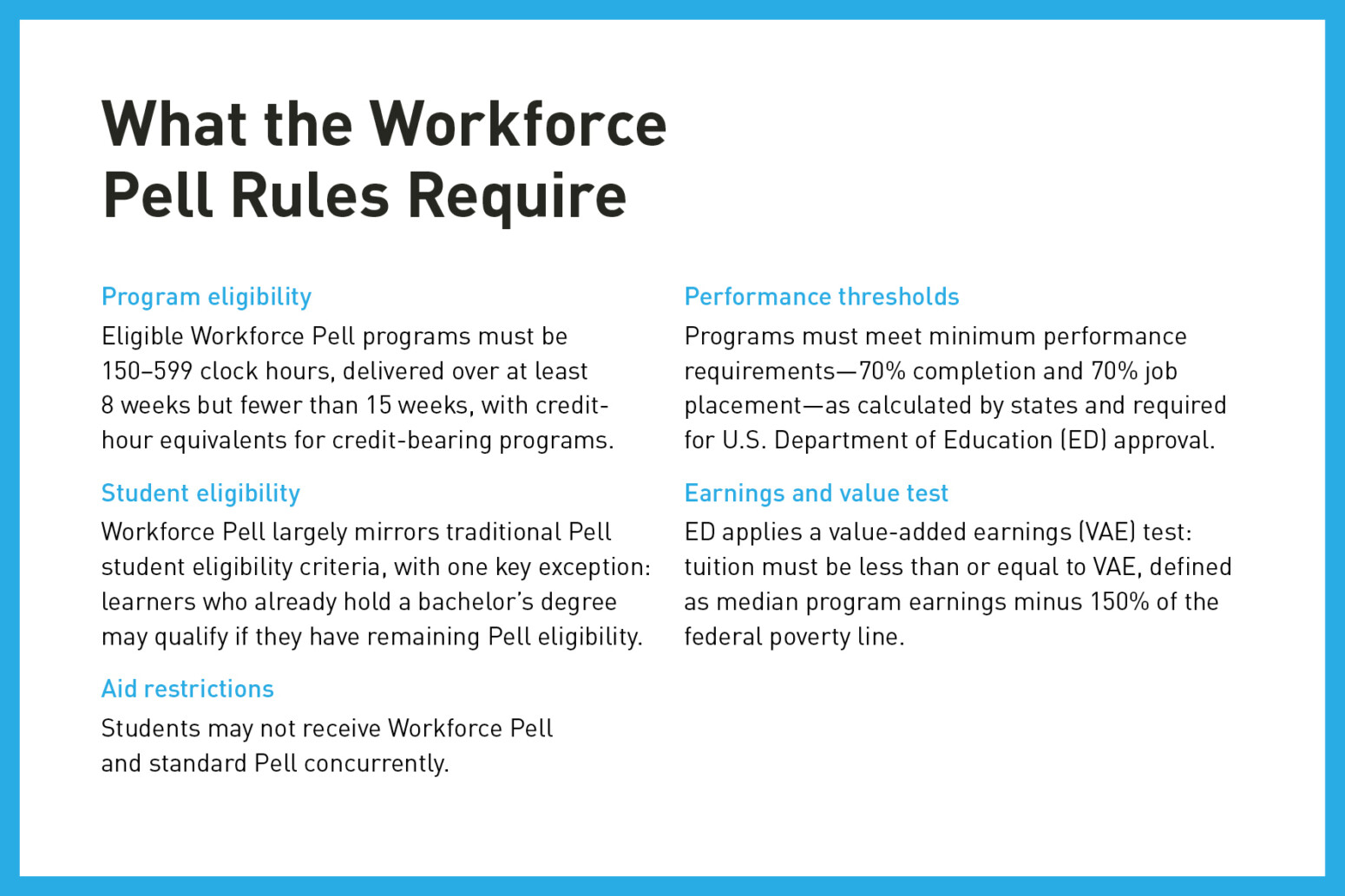
But Workforce Pell is not simply about new funding. It changes what colleges are being funded for, shifting Pell from an access-driven policy to one conditioned on performance and outcomes. Eligibility is tied to state and federal approval processes and ongoing performance thresholds, embedding accountability into workforce funding in a way traditional Pell never did.
Workforce Pell brings instructional quality into sharper focus by linking funding to what programs actually deliver. State and federal policymakers now expect colleges to demonstrate not only access, but high-quality instruction delivered consistently and tracked through measurable student and workforce outcomes.
While colleges propose and deliver programs, Workforce Pell eligibility is determined through a state and federal approval process that begins with a governor-led state review and is followed by U.S. Department of Education (ED) program approval. Responsibility is shared across colleges, states, and ED: colleges must deliver high-quality instruction and track outcomes; states compute required performance rates, and ED approves programs and enforces eligibility rules.
For community college leaders, Workforce Pell is a clear call to action — align programs, instruction, and employer partnerships around measurable workforce outcomes. The challenge is whether accelerated workforce education can now be delivered at scale, with consistently effective teaching and with evidence that learners complete, gain job-relevant skills, and progress into employment.
Why Instructional Clarity Is Critical in Short-Term Workforce Programs
Short-term workforce programs operate under different conditions from traditional degree pathways, designed to move learners into employment quickly and with little margin for delay or recovery. Many students are balancing work, family responsibilities, and financial pressure while completing programs in a matter of weeks or months.
These conditions leave little margin for error. There is limited time for re-teaching, ad-hoc instructional support, or recovery when learning breaks down. As a result, student success depends heavily on instructional clarity, on teaching that makes expectations explicit, connects learning directly to workplace performance, and builds skills through structured practice and feedback that can be delivered consistently across instructors and settings.
When instruction is consistently clear and delivered effectively, learners are more likely to complete and progress into work. When teaching quality varies across instructors, sites, or in-person, online, and hybrid settings, completion and employment outcomes tend to vary with it. This variation matters not only for overall performance, but also for equity: inconsistent teaching disproportionately affects learners who have less room for delay, confusion, or repetition.
Workforce Pell brings policy attention to this reality. As Pell funding expands into short-term workforce programs, colleges are expected to demonstrate that accelerated learning can be delivered at scale with consistent instructional quality and measurable, equitable outcomes.
What Workforce Pell Now Requires of Colleges
Against this backdrop, expectations for workforce programs have shifted, with immediate implications for instructional practice, particularly in how teaching quality is defined, supported, and sustained.
Teaching quality can no longer be variable or assumed. Workforce programs’ reliance on adjunct faculty and instructors transitioning from industry makes consistency of instructional practice more difficult. Subject-matter expertise remains essential, but pedagogical skill is now equally critical; instructors must be able to translate expertise into clear, structured learning experiences that support rapid skill acquisition.
Workforce Pell places increased emphasis on outcomes and return on investment, increasing pressure on colleges to provide evidence of continuous improvement as programs launch, expand, and evolve.
Speed also matters. Pell-eligible workforce programs must remain responsive to employer demand, with minimal lag between training and hire. This increases the challenge of scaling provision quickly while maintaining instructional quality and consistency.
Taken together, these pressures define the operational challenge facing colleges: sustaining high-quality teaching across accelerated workforce education, at speed, at scale, and with evidence that outcomes follow.
Using Workforce Pell to Strengthen All Workforce Programs
Workforce Pell represents more than an expansion of student aid eligibility; it signals a fundamental shift in how workforce education is expected to perform. Federal and state policymakers are no longer focused solely on access to short-term training. They are demanding evidence that workforce programs deliver measurable value, completion, employment, and wage outcomes that justify public investment.
The risk for colleges is treating Workforce Pell as a narrow eligibility exercise, limited to a subset of programs designed to meet minimum federal thresholds. The opportunity is far greater. Workforce Pell establishes a new performance baseline that can and should be applied across all workforce programs, including non-credit, short-term, and employer-aligned training that may never seek Pell eligibility.
By using Workforce Pell – driven measurement as a system lever, institutions can strengthen instructional quality, program design, and employer alignment across their entire workforce portfolio. In this way, Workforce Pell becomes not just a funding mechanism, but a catalyst for raising standards and coherence across workforce education.
Crucially, the ability to sustain high-quality teaching at scale across workforce education — credit, non-credit, Pell-eligible or not — has long challenged colleges. Workforce Pell does not create this challenge, but it makes addressing it unavoidable.
Strengthening Teaching Practice with TeachingHOW2s
This is exactly where TeachingHOW2s comes in.
TeachingHOW2s provides a practical, scalable approach to strengthening teaching practice across workforce education. Its digital platform turns proven, transformative teaching techniques into accessible, step-by-step guides that show educators how to apply effective practice in everyday teaching.
Teaching techniques are provided in multiple formats designed to meet the needs of instructors at different stages of their teaching practice, from instructors new to teaching or recruited directly from industry to highly experienced educators.
Because the techniques are evidence-informed and classroom-ready, colleges can deploy them with confidence, without the need for additional quality assurance or local validation. This makes professional development immediately usable in classrooms, labs, workshops, clinical environments, online delivery, and other applied learning contexts.
This is especially important in workforce education, where instructional staff often include industry experts, adjunct instructors, part-time staff, and experienced educators working across multiple sites and delivery modes. TeachingHOW2s supports this diversity by enabling individualized development at scale. AI-enabled coaching helps instructors adapt proven techniques to their own practice, building confidence and instructional skill without imposing a single model of teaching.
Engagement and collaboration are built into the platform through features such as Skills Exchange, Notes, and the CPD Journal. These tools enable educators to record, reflect on, and review their professional learning, while also seeing how colleagues apply techniques in similar contexts. Alongside usage and engagement data, this creates visible evidence of participation and ongoing instructional development, aligning closely with instructional quality and accountability expectations as workforce provision expands.
Most importantly, TeachingHOW2s helps colleges sustain high-quality teaching as workforce and Pell-eligible programs grow. By making evidence-based teaching easier to understand, adapt, and document, the platform supports consistency at scale while strengthening the everyday instructional practice that ultimately determines whether learners complete, gain job-relevant skills, and progress into employment.
Workforce Pell as a System Lever for Workforce Education
Workforce Pell marks a turning point for workforce education, not simply because it expands access, but because it reshapes expectations. It reinforces that access alone is no longer sufficient. Teaching quality, instructional consistency, and measurable outcomes now sit at the center of federal and state funding priorities.
Responding to this shift requires leadership decisions, not just administrative adjustments. Colleges must move beyond fragmented tracking of outcomes and adopt common definitions, metrics, and quality standards across workforce offerings. Instructional consistency, employer validation of skills, and transparent reporting of completion and placement outcomes must become core operating principles, not grant-specific requirements.
Equally important, Workforce Pell underscores the need for stronger partnerships among states, employers, and workforce boards. Shared accountability means colleges cannot act alone. Governors and states determine performance calculations; employers help define job relevance and placement pathways; and institutions must ensure programs are designed and delivered to meet those expectations.
For colleges, this moment presents both opportunity and responsibility. Those who use Workforce Pell as a system lever, investing in scalable, evidence-based support for teaching practice, will be best positioned not only to meet the demands of Workforce Pell but to build more resilient, credible, and equitable workforce systems that deliver real value for learners, employers, and communities.
To learn more about the HOW2 Platform, follow TeachingHOW2s on LinkedIn for updates and insights.

View Features and Benefits
Latest Insights
More Insights